Society teaches us to believe that sales is the “dirty work” of business.
The truth is that sales (when done ethically) is a noble pursuit and directly tied to client results.
If you truly believe you can improve someone’s life, you have a moral obligation to get them to commit.
This is why you become an expert at selling your services.
Watch the “Sales State Of Mind” video below to get your mind right around sales!
Priorities Matter
Potential patients “not being able to afford” your treatments usually are not about money at all…
… It’s about priorities.
People WILL find a way to purchase if it’s a priority for them.
The interesting thing is that people’s priorities are often NOT aligned with their desires.
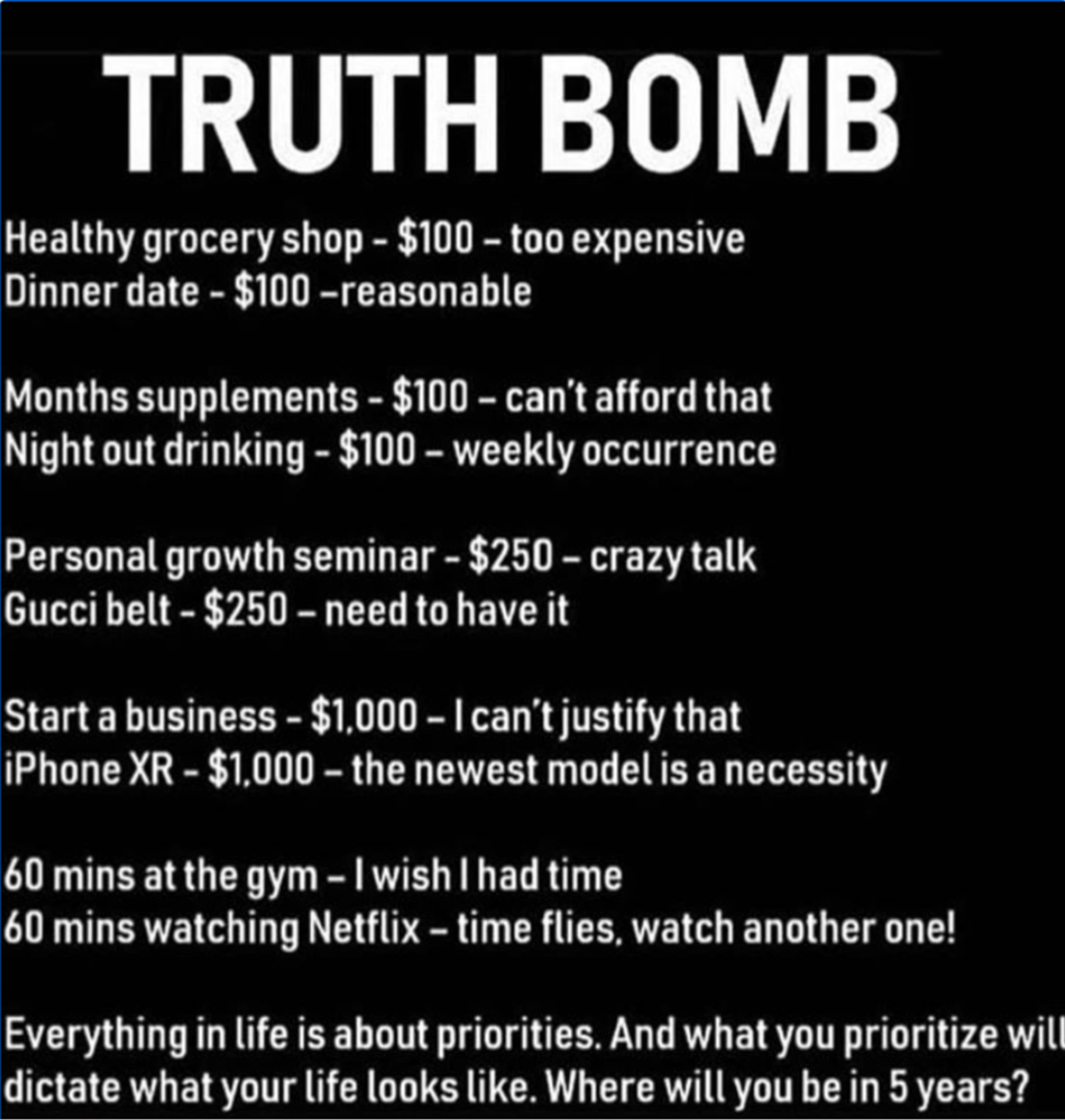
For example, you could have someone who wants to be healthy & wealthy, yet drops $100 every weekend at the bar while scoffing at a $14.95/m Audible subscription.
YOUR job is to help align their priorities with their desires.
This is how out-of-whack people’s priorities are:
Exercise To Align Priorities
Next time you have a patient balk at the price, ask her: “What’s the most expensive clothing item or accessory you own?”
It will probably be a $1000+ pair of heels or maybe a purse.
Then ask her: “How often do you use/wear this item and how long have you had it”
“Ok, so you use that purse maybe 2-3 times per year on special occasions and you’ve had it for 3 years. So your ‘cost per wear’ is currently: 3 years x 3 times per year = 9. You purchased it for $1000 so $1000/9 = roughly $100. Right now each time you use that purse your ‘cost per wear’ is about $100.”
Then ask: “How many times do you go outside with your face?”
Ohhhh damn.
“So if you’re like most people you go outside pretty much every day but in this case to be conservative you only go out in public two-thirds of the days of the year, so roughly 240 days.”
“This treatment package is going to cost $4000 and the results will last all year, so your ‘cost per wear’ on your gorgeous new face will be $4000/240 = $16.That’s $16 compared to $100 and you get to feel amazing EVERYDAY, not just on special occasions.”
When you break it down like this, it becomes painfully obvious how great of an investment cosmetic treatment really is.
Beware Of Labeling People As “Price Shoppers”
“Price-shoppers” aren’t people. Price-shopping is a behavior that happens when people have options.
Let’s imagine you’re in a food court and are in the market for a burger.
If someone tried to charge you $40, you’d laugh and go to another spot.
Now let’s imagine you’re on a road trip and are absolutely starving. You come across the only fast-food joint in miles. The burgers cost $40 each and are average.
—> Are you going to tell them you usually pay $15 and ask if they can do better?
No, you’re going to fork over the funds and wolf down your $40 burger.
Same person. Different environment. Different behavior.
Make Yourself The Only Option
The goal of your sales process should be to present you as the only option.
When people have a problem, and view YOU as the one who can solve it, they will pay.
You may be thinking: “How can I be the only option when there are 7 other clinics down the street?”
Yes, you may not be the only option for Botox…
BUT, you can become the only option for people who want the best possible results and experience.
The challenge is convincing clients of this when on the surface, you offer similar treatments as everyone else.
Advance to the next article, Sales Strategy to discover how to do this!
Transcript
0:01 All right. In this video, we're going to talk about the sales state of mind. Now this video, isn't very tactical in its nature, but it's crucial to instill this mindset, not just in yourself, but in your staff, in order to implement the tactics that we're going to give you, because no matter how many
0:16 tactics you actually have, if it's, if you don't really have the right mindset, driving it, your results, aren't going to be nearly as good as if you had this mindset to begin with.
0:25 So let's first start with this logic. Let's just agree that the people who inquire about your services want to solve a problem.
0:33 I think we can all agree that whenever someone reaches out to you, they have a problem they want to solve.
0:37 And secondly, that's great that people who have problems want to solve them as quickly and as thoroughly as possible.
0:44 And then lastly, with the two points, we can agree that solving people problems for people quickly and thoroughly is a good thing to do.
0:51 So that's, it's pretty obvious. If someone has a problem, they want to solve it quickly. You're being a good person by helping them solve that as quickly and as thoroughly as possible.
1:00 Now let's also agree that you wholeheartedly believe in your treatments and if a patient's a good fit, you have full conviction in your ability to solve their problem.
1:08 And this is a really important caveat because, uh, if you don't have full conviction in your services, you're not really in the right position to sell people on your services.
1:17 If you're not confident with this, it's actually going to help them. So it's really important to have, uh, this agreement as well.
1:23 You have to believe in your services now, full conviction that they're actually going to solve the problem that people come in for.
1:28 So under this logic, part of your job in fixing your patient's problem is to get them to agree to your solution.
1:34 And you could even argue that's your moral obligation to convince your patient to agree to that solution. So if you have a problem that you genuinely believe can help someone part of your job in solving that problem is not just carrying out the service of solving the problem, but actually getting them
1:48 to agree to whatever solution you prescribe and that's sales. And that's why selling is serving. And this is just such an important mindset that people need to, they really need to understand this and really fully grasp this because in society we're taught that selling is really bad and it's an unjust
2:05 thing to do. And you're being a bad person by selling people things. But just by going through that logic earlier, you can see that by prescribing someone a solution that actually helps their problem, you are being a good person and you are serving them by selling them your solution.
2:20 And that's why you must use everything in your tool belt to get them to agree and not feel guilty about it.
2:25 And a classic example of one of these tools is having a same-day bonus. If someone comes in and you put together a solution for them, if you have an incentive for them to start today, lots of people would think, Oh, that's super pushy.
2:38 And you're, you're coursing the person by doing that. When in actuality, people are scared of making decisions because they don't want to make a decision and be wrong about it.
2:47 So providing them an incentive to get started today is just helping them along their journey to actually solve the problem.
2:53 And so that's why you shouldn't be feeling guilty about using these types of tools and tactics, uh, to make the sales, because it's a win-win situation.
3:02 In fact, you should actually feel guilty about selling someone, a subpar solution that won't get them the best results.
3:07 And this happens all the time in business. People feel guilty about selling the package. That's actually going to work because it's too expensive that they undersell themselves and just sell someone something that's not really going to work very well.
3:18 And to just drive this point home, I want to share the story, uh, that my experience that I had at a chiropractor recently.
3:23 So a couple of weeks ago, uh, my back was really sore. So I went to the chiropractor and he did the assessment.
3:29 He did the adjustment, I got great results and I was actually really happy. But at the end of the, uh, appointment, he kind of just whisked me off, sent me to the front desk and told me to pay for my $90 from my assessment and my exam.
3:43 And so when this happened, I just couldn't stop thinking like this businesses losing so much money because they didn't properly choreograph that sales process to prescribe me the best possible solution.
3:55 And just to illustrate how much money they're losing every time this happens, I just made this little chart here. So here's what I actually bought.
4:01 It brought one chiropractic, examining adjustment. It was $90 value. I play, I paid $90. They made $90, but what I could have bought, and I would be told I would have been totally willing to buy this package.
4:12 If they put it together, I would have bought a package of six chiropractic treatments and adjustments because he recommended that I needed six, but I would be booking them one by one, as I go, there'll be a $390 value.
4:23 I also remembered that I bought an Indian rubber ball to roll out my back, but I actually lost it. And I noticed that they had all these back rollers in the waiting room.
4:30 So if they threw that in proactively into the package, that would have been open to buying that I would have also liked if they could add like a stretching guide and assigned at a 20 volt dollar value to increase the value of the package.
4:40 That would be awesome because I would actually remember my stretches. And then they're also part of the wellness center. So I would definitely be open to a packet of massages if there's dirt in there.
4:50 And so the total value of that would have been seven 20 and they could have easily given me a $20 discount.
4:54 If I paid in full that day, giving me a great deal if I committed to the entire package. So I would have paid just under $600 to get this complete package.
5:04 And you may be thinking, well, if you wanted all these things, you would have proactively asked for them. And that's just a huge misconception.
5:11 People need to be, everyone is silently begging to be led. Like it's, there's this funny story where like, let's say you bring your friend over to your house and you just made this delicious new plate of cookies and you to say to your friend, Oh, if you want some cookies, there's a, there's a plate in
5:27 the kitchen.
5:28 If you can go grab them, if your friend, especially if they don't know you very well, which is most people that come into your business, you think they're going to get up and go to your kitchen and take a cookie.
5:36 There's a good chance. They're not going to do that. But if you pick up the plate and bring that warm plate of cookies right in front of them and say, would you like a cookie?
5:43 And all they had to do is extend their arm and pick that cookie up. They're going to say, yes, and it's the exact same thing here.
5:48 You have to put these things together and present it to someone on a silver platter in order to get them to commit.
5:55 And it's a win-win situation because if I would have purchased this entire package, I would have been totally committed to this whole thing.
6:01 And I will gotten much better results because what actually happened is something came up the next day. And I had to cancel my second appointment that I booked at the end of my first appointment.
6:11 And I haven't even, I didn't even reschedule. And I don't know if I ever will reschedule, because right now my back is kind of sore, but it's not the pain.
6:20 Isn't really enough for me to go out and book another appointment. So I'm just sort of left in this limbo land where I'm not really doing anything about my problem.
6:28 And I'm just kind of, I'm not really doing anything about it. And that's what consumers do. They get busy life gets in the way, even though they still have a problem that needs to be solved.
6:37 They're not going to go out of their way to move the move, the treatment plan forward.
6:42 If you don't actually get them to commit up front. If I paid five 76 upfront, I would have been much more invested into the program and I would have made sure I actually got the rest of those appointments booked in the clinic with too, because they had that money in hand.
6:56 And so when people pay, they pay attention. And when, since I only paid $90, it's like, I didn't invest that much into this whole solution.
7:03 So I'm not going to be invested as much to actually carry out the rest of the treatments. And so it's up to you to take your customer by the hand, to every step of the process, to ensure they commit fully, don't leave it up to them.
7:15 Don't assume that people are going to proactively do everything they need to do to get the best results you have to assume everyone's lazy.
7:22 Like I am and just set everything out there and make sure they commit to that full solution that you prescribed them and don't feel bad about it.
7:30 So just to bring this whole video together, we will provide you with the tools to sell, but it's up to you to cultivate a positive mindset around sales, because you can be given all the tactics, hacks and strategies available in the world to sell.
7:42 But if you don't have that foundational positive mindset that you're genuinely serving people by prescribing them a complete solution, then everything from there just gonna be an uphill battle.
7:50 So, so hopefully that anecdote, the chiropractor really hammered home to you, that selling good. And now that we have the mindset over with, let's get to the more fun tactical videos like the discovery call script consultation, script, packaging, and pricing sheet.
8:04 So you can start booking the appointments and closing $2,500 plus packages as soon as possible.