The closing process begins upon completion of the consultation script & presentation.
By this point, you should have established 2 things:
- The client has a problem they want solved now.
- You are confident you can solve the problem with what you have available.
At this stage, you are ready to recommend a solution and close!
Here are the steps:
Step 1: UNSELL What They Don’t Need
This is where you literally cross out treatments the client doesn’t need.
It sounds backwards, but it builds trust. People aren’t used to salespeople unselling services. Saying what they don’t need gives more power to your other recommendations.
Whatever format you’re using to present the treatments to the client, make sure you visually highlight the treatments they don’t need.
The Tailored Treatment Plan
The Tailored Treatment Plan (TTP) is a powerful tool for building packages and then customizing them to the individual needs of a client.
The TTP comes in two forms: digital & physical.
The digital version is best for building intro offers, planning out packages, and calculating margins.
The physical version is best for constructing packages, live in person with a client in the consultation room.
Whether you’re using the physical or digital version, start out by crossing out the treatments the client does not need.
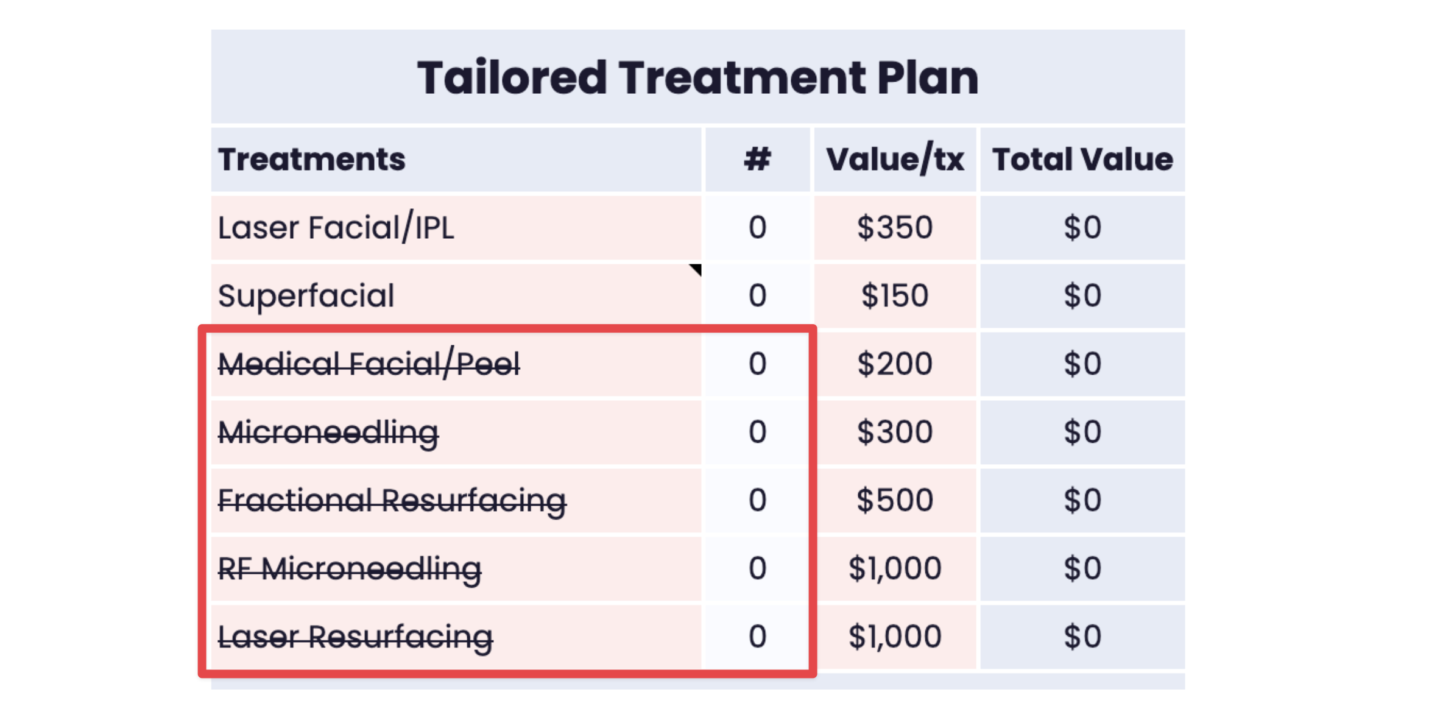
As you’re crossing out services, explain what you’re doing.
“Based on what you’ve told me about wanting to look refreshed for your daughter’s wedding in 3 months, you won’t need treatments XYZ that cost $12,000 total. Those are better for different concerns.”
💡PRO TIP: Saying the total price of the treatments you crossed out takes advantage of price anchoring - a psychological effect that makes your recommended option feel much more affordable compared to the higher total you just mentioned.
Step 2: PRESCRIBE What They DO Need
During the consultation, you will discover what the client needs to solve their problem.
- Maybe they need a series of 3 IPLs for their pigmentation.
- Maybe they need 40 units of tox and a few syringes of filler.
- Maybe they need skin care.
- Maybe they need all of the above.
Recommend everything necessary to achieve the patient’s desired results, regardless of cost.
Don’t Prejudge: It’s easy to assume someone can’t afford treatment just by how they look or act.
The truth is you never really know. A client once told me he had a school bus driver pull $5000 cash out of her pocket to pay on the spot.
Everyone deserves an equal chance to buy. Don’t short-change people based on looks.
You can use the Tailored Treatment Plan to build out the recommendation. Simply enter or write out the number of each treatment the client needs.
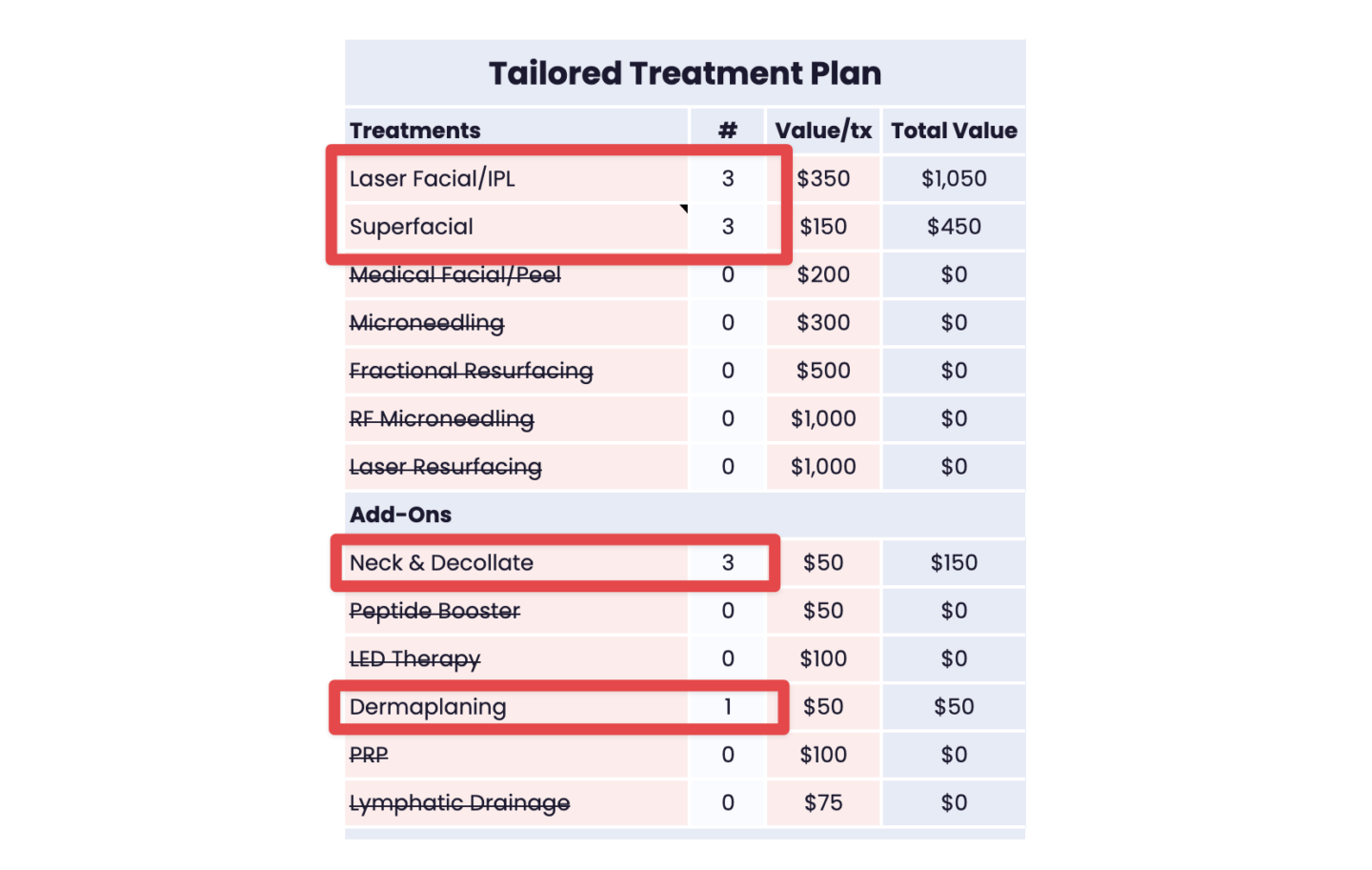
As you’re doing this, explain the reasoning behind each recommendation:
“Since you mentioned wanting smoother skin and to look great in lower-cut tops, I recommend three laser facials with HydraFacials, plus the décolleté area so it blends. We’ll finish with dermaplaning for an even, glowing look.”
You should NOT feel like you’re being pushy when you do this.
Assuming you have done a proper discovery and know what the client needs, you’re simply prescribing a plan.
You are the expert here. Prescribe with the authority of a well-respected family doctor.
Step 3: Value Stack & Discount For Pay-In-Full Today
Lastly, add up the total value of the treatments and then give a 20% discount if the client pays in full TODAY.
“Based on what you told me, here’s what we’re going to do: [brief plan]. You’ll get [X treatments], [Y visits], [Z aftercare]. The total value is $[Value]. If you take care of it today, it’s 20% off at $[Full Price x .8]. Does that work for you?”
Pause. Shut Up. Let them answer. (VERY IMPORTANT TO LET THEM ANSWER FIRST).
💡Tips To Close More
1) Take advantage of A/B closes
A/B closes give the choice of how they would like to move forward, while NUDGING one choice as the popular option.
This gives people the satisfaction of choice without the overwhelm.
You can turn almost anything into a choice. Test a few, then go with what works best for you.
“Do you want to get started today or Monday?”
“Do you want to do it with or without the dermaplane? Most people do the dermaplane so their makeup goes on better.”
“Do you want to do it with or without the exosomes? Most people do the exosomes so they can heal faster.”
“Do you want to do it with or without skincare? Most people do the skincare because the products are matched to the treatments.”
IMPORTANT: Do not introduce a third choice for this step. Two options only.
2) Make it EASY to pay
Assume the sale. “Perfect - want to use the card we have on file or a different one?”
People don’t realize that there is a second microdecision after someone decides they want to buy, where they need to retrieve their purse and decide which card to pay with.
Don’t let people drop off during this step. Using the card on file is a way
💉 Injectable Closing Strategies
Get People To Show For Injectables Follow-ups
Offer a free treatment to incentivize clients to show up for injectable follow-ups.
Implement the following conditions to prevent tire kickers from wasting your time:
Condition 1: The free treatment should only be offered if they book their second appointment THAT SAME DAY while in the clinic.
Condition 2: The client can only reschedule their second appointment ONCE. If they need to reschedule more than once, their free treatment will be lost.
Cross-Selling Between Injectables & Skincare
Have one of your aestheticians step in during injectables prep. This is a perfect opportunity to discover their skin needs and book a skincare consultation. You can also have your injector introduce themselves before/during/after a skincare treatment to expose the patient to injectable treatments.
Visit the Injectable Sales Masterclass training for further instructions.
Transcript
0:00 All right, in this video we're going to walk through the recommendation section of the closing process. So at this point you've already gone through the consultation with the client, so you've already assessed their skin, you've educated them on their treatments, and by this point you should have established
0:14 two things. The first thing is that the client has a problem they want solved now, and the second thing is that you are confident you can solve the problem with what you have available.
0:22 This is super important because a huge mistake people make in sales is they start recommending things before actually doing a proper assessment and understanding that person actually wants to solve the problem.
0:34 So make sure that you go through this whole process, you understand it before getting to the actual recommendation. So, assuming you've done these two things, you're now at the stage where you're ready to recommend a solution and close.
0:45 Step one is to unsell what the client is doesn't need. This is where you're literally going to cross out the treatments that the client doesn't need.
0:53 It sounds backward, but it actually builds trust because people aren't used to sales people unselling their services. They're always used to being told, oh, you need this, this, and this.
1:01 And when you actually cross off what people don't need, it builds a lot of trust and gets them to really listen to what you recommend they do need.
1:09 Now, there's two ways you can do this. The first way is through the digital version of our Taylor treatment plan.
1:14 The Taylor treatment plan is a tool we use to build packages, um, both before you see the client and then also during these, uh, the time seeing the client, you can build a package live with them.
1:24 So if you click on this link, it's going to open up the digital version of the Taylor treatment plan. And I have a training that walks you through how to use this.
1:30 Most of our clients, however, prefer to use the physical version, which is an actual sheet that you're going to print out.
1:36 So what you do is you update this Canva template, you update it with your treatments, you print it out with the client, and then you're actually just going to use a pen to cross out what they don't need.
1:46 So you're going to do the consultation, I'm sorry, do the recommendation, and then what you're going to do is as you describe, uh, what they don't need, you're, you're going to cross it out and describe it.
1:56 So for example, you could say, based on what you've told me about wanting to look refreshed for your daughter's wedding, in three months, you won't be needing treatments X, Y, Z that cost $12,000 total.
2:05 Those are better for other concerns. So it's really important to say the price and make it very clear that they don't need those treatments because what this does is it also takes advantage of a psychological effect called price anchoring that makes your cheaper treatments seem much more affordable in
2:22 comparison to what you crossed out. So the price person may have a budget of $1,000. If you cross out something that's $10,000, they're gonna be, oh my God, thank God I don't have to pay 10,000.
2:32 And then they may even stretch their budget to two or $3,000 because they're relieved they don't have to pay 10,000.
2:38 So this is a super, super important step where you're going to cross out what they don't need. Step two is to prescribe what they do need.
2:46 This is why it's important to do the consultation. You're going to discuss what whatever what the person needs, and you want to recommend whatever you think will get them the best results regardless of price.
2:54 So maybe they need three sessions, sessions of IPL. Maybe they need 40 units of talks and a few syringes of filler.
3:00 Maybe they need skincare. Maybe they need all of the above. What you're going to do is recommend what they need regardless of cost.
3:07 And this is really important here to not prejudge. This happens a lot, right? Someone comes in and you don't really think based on their looks or appearance or the way they act or whatever it is, you're going to subconsciously start to assume that they might not be able to afford your best package.
3:21 This is a really big mistake because a lot of people will surprise you. And I'm sure you've had experiences like this where you don't think someone's going to spend, and they pull out a wad of, you know, $2,000 cash and pay for their treatment plan up front.
3:33 So it's really important to not prejudge and recommend whatever you think will get them the best results, regardless of cost.
3:40 Everyone deserves an equal chance to buy. So if you're using the digital version of the tailored treatment plan, you're going to actually just write the numbers in the Excel sheet.
3:49 But if you're using the physical version, you're just going to write down how many of each treatment the client needs, and then just multiply the number of treatments by the value to get the total value of each treatment.
3:59 This is really important because you want to start showing, adding up the total value of the package, uh, because at the end, you're going to give them a discount and they're going to see how much they see, how much their savings, next.
4:09 You also want to explain the reasoning behind each recommendation. So as you're recommending the treatments, explain why you're recommending that and tie it back to what their goals were to make it make sense.
4:20 Everything that you're offering. You shouldn't just be offering treatments just because. You're offering treatments because that's, what's going to get them to their goals.
4:27 this is why you should not feel like you're being pushy when you're doing this. You're simply recommending what they need based on their goals.
4:35 Set three is to value stack and discount if they pay in full today. So you're going to add up the total value of the package.
4:41 And what you're going to do, you're going to say this in total, this is how much, this is how much the value is.
4:47 And if you pre-pay today, pay in full, I'm going to give you a 20% discount. So we prefer a 20% discount.
4:53 It's a standard. You can discount whatever you like. But a 20% discount is enough for the person to feel like they're getting a good deal.
